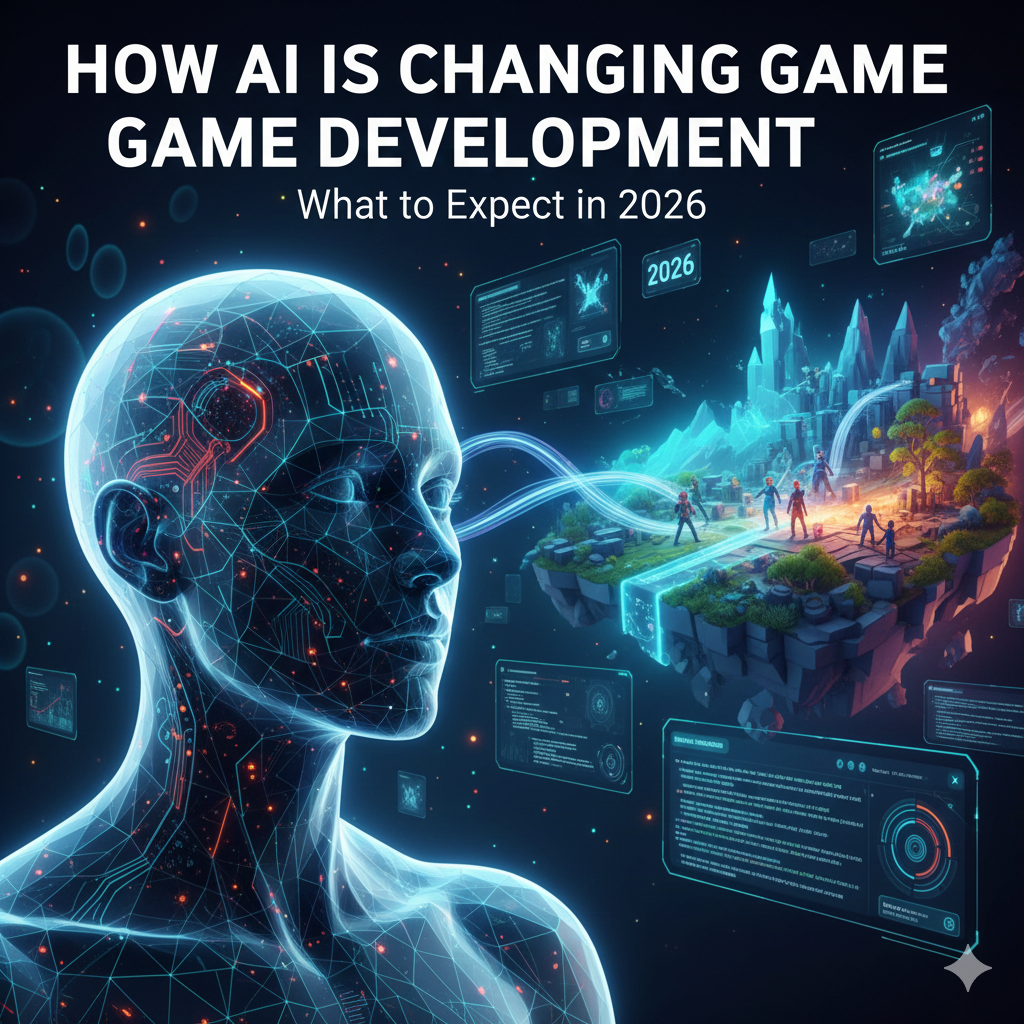
Artificial intelligence has already transformed the gaming industry — from smarter NPCs to automated world-building — but 2026 is expected to be a turning point. As AI tools become more advanced and accessible, game development is shifting from time-consuming manual processes to intelligent automation and creative collaboration between humans and machines.
For gamers and developers alike, the future looks more immersive, personalized, and efficient than ever before. Let’s explore how AI is shaping the next wave of game development in 2026.
🤖 1. Faster and Smarter Game Production
Traditionally, building a game required months or years of manual work — designing assets, coding mechanics, creating animations, writing stories, and testing.
By 2026, AI is expected to automate a significant portion of these tasks:
- Auto-generation of 3D models and textures
- AI-assisted animation and rigging
- Procedural level creation
- Automated debugging and optimisation
Developers will spend less time on repetitive tasks and more time on core creativity and innovation.
🌍 2. Hyper-Realistic and Dynamic Worlds
AI is accelerating procedural world generation, enabling developers to create vast, believable worlds in record time. By 2026, players can expect:
- Worlds that expand as players explore
- Environments that evolve based on player decisions
- Weather, physics and ecosystem systems powered by AI
This leads to living, breathing environments that feel unique to each player.
🧠 3. Emotionally Intelligent NPCs
Gone are the days of predictable NPC behaviour. AI-powered NPCs in 2026 will be:
- More human-like in emotion and decision-making
- Capable of learning from player actions
- Designed to create dynamic storytelling paths
Each gameplay session may offer different results depending on how players interact with characters.
🧬 4. Personalized Experiences for Every Player
AI-driven personalization will redefine player engagement:
- Missions and storylines that adapt to playstyle
- Difficulty levels that tune automatically
- Rewards and challenges designed around player preference
No two players will have the exact same journey — making replayability more exciting than ever.
🎤 5. AI-Powered Audio, Dialogue & Storytelling
Narrative and audio creation is becoming more dynamic through AI:
- AI-generated voice acting and sound effects
- Real-time dialogue variations based on gameplay
- Story arcs that branch intelligently
Games in 2026 will feel more cinematic, dynamic, and emotionally engaging with seamless storytelling integration.
🧪 6. AI in Game Testing and Security
AI is already improving stability and security. In 2026, it will enhance:
- Bug detection and optimization
- Play-testing simulations to predict player behaviour
- Anti-cheat systems powered by machine learning
This means fewer launch-day glitches and fairer gameplay.
🚀 Final Thoughts: The Future of Gaming in 2026
AI is not replacing game developers — it’s empowering them. Expect 2026 to mark:
- Shorter development cycles
- More creative experimentation
- Higher-quality gaming experiences
- Personalized adventures for every user
The next generation of AI-powered game development will blur the line between reality and imagination — making games more immersive, adaptable and emotionally compelling than ever before.